

Friedrich Karl Gotsch
Pries bei Kiel
1900 -
Schleswig
1984
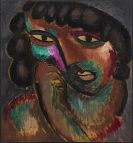
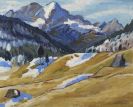
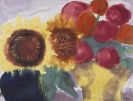
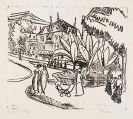
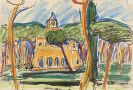
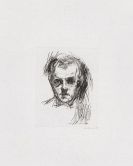
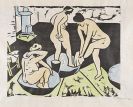
After graduating from secondary school, Friedrich Karl Gotsch, who was born in 1900, volunteered for the military from 1918 to 1919 and then began to study, which he soon gave up again. In 1919 Gotsch took private lessons with the painter and graphic artist Hans Ralfs in Kiel. In 1920 the artist had his first solo exhibition at the 'Kunsthalle Kiel'. His teacher Ralfs introduced him to the works of Edvard Munch, whom he regarded as a role-model throughout his life. In 1920 Friedrich Karl Gotsch transfered to the 'Sächsische Akademie der Künste' in Dresden, where he first studied under Hettner and then, from 1921 to 1923 as master student under Kokoschka. During these early years his style was strongly influenced by the Expressionist paintings of his teacher, which he accentuated with graphic elements. At that time Gotsch also worked as a graphic artist and was very productive. During the subsequent years a prolonged trip to the USA was followed by study sojourns to Paris (1926/27), Italy (1928), Southern France (1929) and Munich (1932/33). In 1933 the artist moved to Berlin, but there, the Nazis increasingly hindered his work. In 1939 Gotsch was drafted and served in the war, working mainly as an interpreter. His Berlin studio was destroyed by bombs. In 1945 the artist returned from a British prisoner-of-war camp to Eiderstedt. Gotsch, who mainly worked in culture politics in the post war years, refocused entirely on his artwork from 1951. After a phase of intensive studies of Picasso's Cubism and experiments with abstract techniques, the artist developed the 'late Expressionism' which was typical for his later work. Even during his lifetime Gotsch was highly respected as one of the few artists of his generation who painted representational pictures. The painter participated in numerous exhibitions and received well-known awards. When a large part of his works were accepted in the collection of the Geneva 'Petit Palais' in 1964 and the 'K. F. Gotsch Stiftung' was founded at the 'Schleswig-Holsteinischen Landesmuseum' in 1968, the artist's talent was soon recognized beyond the borders of his region.


Would you like to sell a work by Friedrich Karl Gotsch?
Infos for seller


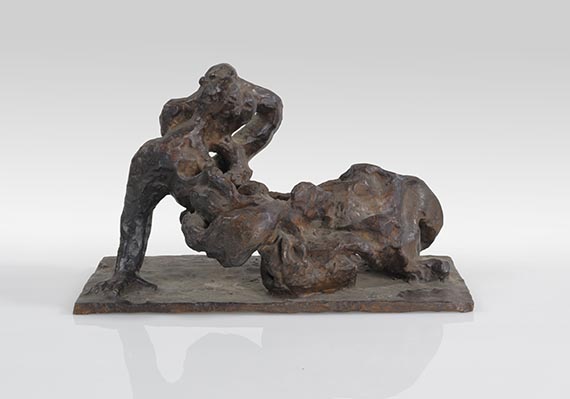
Starting bid: 4,500 EUR